Review
The Capacious Magnetism Of Steve McQueen’s Bottom
by J Nash (October 4th, 2010 at 9:33 am) WITH SPECIAL GUEST STARS

Game: Luxor. Publisher: Mumbo Jumbo. Supports Play+. Price: 59p. Buy the game or get the demo.
The trouble with suspension of disbelief is that it only takes one jar to bring it crashing down. Take, for example, Papillon, the celebrated movie adapted from the best-selling true-ish book about a bloke condemned to Devil’s Island in the 1930s for a crime he did not commit who ricochets around the French penal system for years from one competitively inhumane department to another but who never surrenders his soul — an affirmation of the indomitable human spirit and so on, like a 70s Shawshank Redemption with slightly fewer laughs.

You are gripped by the exotically grimy story. Not long after the initial injustice and a few preliminary batonings, star S McQueen finds himself caged alongside D Hoffman, who reveals the secret of survival in this farcically grotesque system: bribery. Like Newgate, the difference at Devil’s Island between life and death is a succession of discreetly passed currency notes. And, as everybody is, by definition, corrupt, the only way to retain your money until the critical moment is to roll it up tightly, screw it into a canister and hide it inside your bottom: a briny-bracing lesson in the realities of prison existence and a demeaning symbol of the predicament of S McQueen, a man whom one instinctively feels does not ordinarily conceal items within his person. Becoming fast friends over this vital tip, S McQueen and D Hoffman then spend the rest of the film slipping money to guards so they can move to slightly better quarters, obtain privileges like edible food, attempt quasi-sanctioned breakouts, etc etc; eventually, through the sheer invincibility of human grit, escaping a disused corner of the fatal knoll by leaping into the foamy sea and floating away ricketily on coconut rafts.
The thing is, whenever the plot requires advancing, a guard is bribed to look the other way and, after around the third such incident, all you can think about is the logistics of retaining a decade’s worth of money up your bum. S McQueen is beaten mercilessly and thrown into a cripplingly tiny stone chamber: the whole of your attention is on how big the denominations must be to wrap into an easable roll without inconveniently running out after the fifth or sixth year, especially as bribes obviously don’t come with change. The characters resolutely endure punitive hardship and arbitrarily inflicted torture; you’re looking for a currency converter and imperial tape measure. It hurtles you out of the adventure and suddenly all you can see is a toppling dominoes of every tiny thing that’s stupid. No longer is charismatic S McQueen the rugged and uncrushable wronged: in every frame he’s jostling aside your immersion as the terrible actor who marked victory in the original and rubbish The Thomas Crown Affair by jerking back his head and saying, “Ha! Ha! Ha!” and is now wasting your time with his incapability to realistically wear his own genuine beard.
Hello, it’s Luxor.

Luxor is a variation of the game that made Popcap’s fortune, Puzzloop, crossed with a bit of Arkanoid. You’re a gun tilting back and forth beneath a variably twisty maze. Tiny blokes push queues of coloured balls through the miniature labyrinth. You lose if they reach the end. The idea is to knock out the balls by firing the same colour into the queue, forming (or augmenting) an unbroken line of at least three. There are chain reactions and power-ups and such.
For a long time you’ll be thoroughly enjoying Luxor. It is exceptionally polished, with invisibly precise controls and an unusual Egyptian setting packed with atmosphere. (The tiny pushblokes aren’t even animated, but exhibit more character than most games’ antagonists through their winningly undismayable toil, even after being hurtled halfway back around the screen when you’ve stumbled on an explosively lucky combo.) It’s match-three, but a finite number of pushblokes each rolls a set queue. The clever way the pushblokes slow down the nearer they are to the exit crosses last-ditch thrills with colliding patterns as the later pushblokes catch up. You’ll play for ages just shooting your auto-loaded ball before realising you can twin-tap the screen to flick between the two available at any given time. Missing the queue entirely with your shot incurs no penalty (and in fact can be handy when both loaded balls are exasperatingly the same useless colour). Power-ups crash out of the eliminated balls in diverging arcs, you zip across the field to catch them all, things blow up, lightning creases the screen, a furious choir approves with an echoing, “hhhooooooOOOO-HAH!”, your bus turns up in the middle, you poke the iThing off, the game auto-saves that exact moment and later restarts conveniently paused.
Splendid.
Then you notice that when you fire a ball into a queue it automatically pushes everything forward one space — matching colours only explode afterwards and balls only roll back into empty space if the exposed ends are the same colour (or there’s nothing directly in front of a pushbloke). This can’t possibly be important and you carry on for a few more levels, reaching the double loops and fiend underpasses where more often than not your only clear and helpful shots are at the very end of the queue as it inches into the lethal exit, and then you realise the terrible error Luxor‘s designers have made. Because matching colours aren’t resolved until your fired ball has clunked into place and pushed the queue ahead, and gaps don’t close over unalike colours, you can lose the game with a clearing shot.
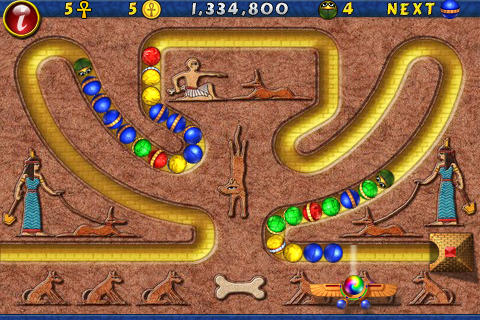
Let’s say there’s a yellow ball right at the exit, a bare second from disaster. Behind it are two blue balls and a red. Your shot is a blue. You fire! You connect three blues, which blow up! You lose, because red and yellow don’t attract, so your fired blue has auto-pushed the yellow into the catastrophe bin. It’ll take you a couple of killed lives to accept the spectacular idiocy of what’s happening, but that’s exactly what’s going on. Given the tangled layouts of later mazes, there’s a certain point beyond which a level is irrecoverably lost. You can’t get back on top — you keep bursting colours along the line to clear space, the queues keep lengthening anyway because the resulting edges don’t mesh. It’s the equivalent of, say, Tetris deciding that if you let the screen fill over three-quarters then clearing lines no longer counts, but not telling you until you’re baffledly nosing the ceiling.
(Of course, there are gaps between the pushbloke queues, and a gap itself is a breathing space until you knock out the leftovers or at least expose a matching edge — the game has the grace to fill the space with your ball if you fire into a gap, rather than rolling everything forward again — but as each pushbloke rolls into dead air or catches up to the slowing one in front, they collapse into fewer lines. And, obv, the mazes twist crazily with legit trickiness to the point you can only shoot one queue because the others are circling behind it.)
This happens a lot.
(And it’s such an easy fix — all you have to do is blow up the initial connection first, pushing the queue forwards only if the player’s matched nothing.)
Suddenly the unfairness has propelled you out of your lively wee game and all you can see is the other design mistakes. Despite the dead area at the bottom of the screen where you slide your gun (and where you’re naturally looking most of the time) the Next Ball icon is in the top right, disguisedly bunged in the score bar. If your shot in the air knocks out the last such colour on the screen and your next loaded ball is that colour too, the loaded ball helpfully and silently changes to something else at exactly the point your concentration’s flicked away from it. Some power-ups give you a special ball to fire (eg a bomb) but some activate immediately on being caught — in all the kerfuffle you’re probably not going to notice which bland icon is which — and depending on circumstances some of the instant rewards are positively dangerous. (For example, one temporarily reverses the queue direction, except by the time you’ve instinctively caught it you’re a step ahead and firing your next ball, which now crashes into the wrong place as the complicated patterns weave and knit backwards through the maze. There’s no aural cue when the reverse wears off, so if you notice in time you end up having to hang around waiting for the stupid effect to die.)
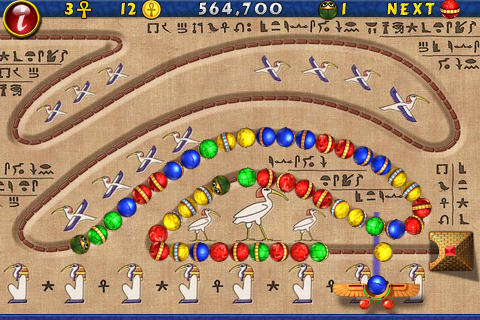
Also, there are at least 88 levels in Luxor and, when you lose all your lives (for example, on maze 9.8, or about 54 levels and over a fortnight in of rapid impulsive goes), the game deletes your save file like it’s 1982 or something.
Blah.
Luxor is a lovely bus game, and then you twig and from that point the idiot errors are all you can see and I never want to play it again for the rest of time.
REVSTU SAYS
To be fair, the ball-shoving-taking-priority-over-a-match thing is a feature of pretty much every Puzzloop/Zuma game ever, and is simply a factor that has to be considered in play – what you’re supposed to do is quickly make gap-spanning matches BEHIND the line of balls that’s nearing the exit, so that all the balls in the line will shuffle back to make enough space. But deleting the save file is face-punchingly terrible, so carry on.
J NASH REPLIES
In that case, whoever designed the original game everyone’s been ripping off for years is a big fat idiot, because that’s a needless encumberment that makes no sense. Even if you willingly discount the fact that EVERY thing-matching game from Tetris to Puyo Puyo includes the simple logical instantly graspable fact that making a connection is always good for the player (ie, even if it spoils your big planned combo or something, you’re not directly penalised for clearing space), it’s a bafflingly counterintuitive rule that adds nothing to the game but barges disastrously into the way.
(See all the Tetrises after Tetris for an obvious example of busywork meddling with perfectly sound rules for a fun game.)
As I say, it took me DAYS to work out what was happening and even then I assumed I was doing something wrong. My immediate guess after I lost the first game was that the dead gaps were an option or maybe a loony difficulty level thing comboed with deleting all your progress — “FOOLISH PEON! DARE YOU GAMBLE YOUR ENTIRE GAME?”, etc — but it’s the same on Easy, Normal and Hard; the only material difference is the pushblokes’ speed.)
Once I realised what was going on, obviously I shifted from the end of the queue to the middle — in fact, I popped awake one night imagining that was the answer and kicking myself for appearing such a fool — except it’s just the same stupid ruinous rule only further back. (The queues are still pushed forwards, obv, and the increasingly twisty mazes block off anything up to most of the screen.)
As with any thing-matching game, you’ll at times during a round be almost completely stuck and have to improvise wildly — a stream of unhelpful Tet shapes, exactly the wrong Puyo colours twenty million times in a row, etc etc — but the point is that it’s only with the Luxor style that you can lose by keeping up.


You must be doing it wrong. I played through all the levels in Luxor without ever losing all my lives (I had close to 30 left at the end), and it took me less time than Stone Loops of Jurassica, which is probably my favourite podgaming Puzz Loop variant. Anyway, I got Luxor when it was free, but wouldn’t have felt hard done by at all if I’d paid 59p for it.
Good to see someone mention Stoneloops, given the heavy-handed thuggery that was applied to it by Poopcap.
That typo was entirely accidental, but I’m going to leave it in.
Hahaha, Poopcap.