Feature
Angry Birds & The Magic Equation
by RevStu (October 6th, 2010 at 12:12 pm)

As someone occasionally mystified by the rubbish that people buy on “grown-up” consoles, I find the App Store a much more rational place. I can account logically for the success of almost every big hit in the Top 50 – Fruit Ninja and Flight Control and Flick Kick Football are brilliant games, FIFA and Tiger Woods enormous franchises with 20-year histories, Peggle and The Secret Of Monkey Island are excellent conversions of classic titles sold for a tiny fraction of what they cost on other platforms, and so on.
Even Doodle Jump can be explained away (despite the presence of numerous near-identical but superior games) by a combination of fortuitous timing and commendably-frequent and substantial updates bolstering an unspectacular but still pretty enjoyable game.

But as for the 10-month chokehold exerted on the top of the charts by Angry Birds, I just don’t get it.
I must admit, I haven’t progressed very far to make that judgement. The first time I played the Lite version I got stuck on the fourth level (ie 1.4), and after about 50 attempts to hit the exact pixel the game had arbitrarily selected as the “right” one to solve the stage I gave up, partly out of frustration but mostly boredom. I just didn’t see the entertainment value in repeatedly stabbing at a giant fruit cake with a knitting needle in the hope of blindly hitting a particular raisin. Subsequently, out of duty, I ploughed through to the end, but the game’s fundamental characteristics didn’t appear to change any and I had no more fun.
Angry Birds, in fact, reminds me a lot of the worst aspects of the seminal puzzle game Lemmings. Which is to say, it’s nearly always obvious what you’re supposed to do, but the game then makes actually doing it a miserable fiddly chore, based on a demand for extraordinary precision that it doesn’t give you the tools to achieve. Your bird catapult comes with no calibration, no way of knowing that your last shot (which fell just short) was fired at 65 degrees and 90% power and so maybe you want 64 degrees or 92% next time. You have to guess both trajectory and power, based on looking at a tiny area of a tiny screen and made worse by having to zoom right out if you want to have any idea of where you’re actually shooting.

The one concession the game makes to helping you aim, a dotted guide line of your last shot, is vague and useless even when it isn't near-invisible against the backdrop.
And if you do manage to somehow fluke it despite all these handicaps, the game measures your success by equally haphazard and impenetrable rules. Beat the first stage with a single shot and you might be awarded one star or the maximum three for what appeared to be two identical outcomes, with no clues as to why one was deemed better than the other. Neither clearing a level nor getting the maximum score for it involve any repeatable skill, they’re simply lotteries. It’s basically like playing golf blindfolded – take 100 swings in the dark with someone pointing you in approximately the right direction and eventually you’ll get the ball in the hole, but you might as well have gotten a monkey to do it for all the pride you can take in the achievement.
(Come to think of it, getting a monkey to do it would actually be much more impressive.)

A game of precision and fine-tuned skill, yesterday.
So why has it sold millions? Frankly I haven’t the foggiest – it’s not like the App Store is short on cute cheap puzzle games that are a hundred times better, and it can’t just be because people buy whatever’s in the top 10, because it had to get into the top 10 in the first place. Interestingly, though, the game’s developers claim that it’s all maths.
According to an interview in the print edition of this month’s Develop magazine, Finnish studio Rovio claims that it has uncovered a “magic equation”, a formula that guarantees a game’s success. Naturally they don’t spell out what this equation is – indeed, the company’s COO Niklas Hed says “It’s easy enough to make an equation for the outline of a good game, but with making a really good game there is this magic in it that you can’t define so easily… it’s about setting up a place where you can find the spark needed” – but they’re adamant that it exists. (“I’m so glad we have an equation like this, because we know why we made Angry Birds as successful as it is.”)
If so, it’s obviously been a while in the making – none of Rovio’s dozens of previous games ring any triumphal bells (anyone fondly recall War Diary Torpedo?), and neither of their previous iPhone games – ponderous 2D horror adventure Darkest Fear and horribly complicated stacking puzzler Totomi – are names carved in the pantheon of App Store smash hits either.
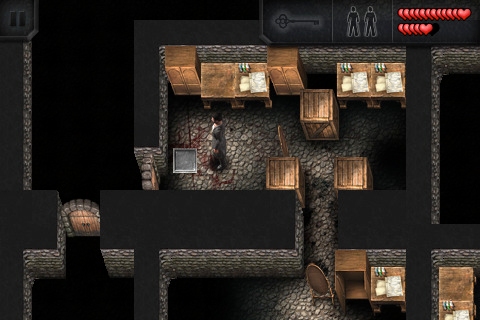
Remember this? Nope, nor me.
But maybe they only just perfected it. I guess until Rovio’s next game arrives and we see whether they really do have a foolproof recipe for making multi-million-megahits, a “magic equation” makes as much sense as the explanation for Angry Birds as anything else.


I’ve three-starred every level in Angry Birds and I don’t think there’s as much luck as people seem to think, though it obviously plays a part. (It’s certainly no Slingo.)
On the majority of levels where I’ve been stuck on two stars, it’s been a change of approach that’s seen me get three stars, rather than just flinging the birds the same way until it magically all works out. (Though there are a few annoying levels like that.)
I think I love Angry Birds so much – and I do – because:
1 – The physics make sense to me, though this may because I’ve played so much of it.
2 – I like the aiming mechanic, it feels nicely tactile. (And I can aim for a tiny blank sandwiched between two huge blocks without too much trouble.)
3 – The level design is mostly based on working out where and when to hit the structures, so it’s about having an actual plan.
4 – It looks adorable.
5 – I play with the sound off so I’m not being driven mental by the bird noises.
6 – You’re not constantly involved and can pause as long as you like between shots, so you can play while watching the telly, chatting, etc.
what a terrible article. The Writer clearly has no skill if he can’t even complete the lite version. You don’t have to hit an ‘exact pixel’ on any level to progress – you must just be rubbish. Angry Birds is the best ever game on the iPhone… and the million+ people who have purchased (and rated it 5-stars) back up that claim.
The nearest I’ve come to explaining the appeal of Angry Birds to so many people is that, as with something like Peggle, it allows for the delusion of skill. That is, when you succeed after doing the same thing 75 times with a pixel of difference each time, the spectacular results feed the illusion that you’re a genius and you forget the 74 times you failed. As I said in the piece, I’ve one-starred and three-starred the same level with what to me felt like identical shots – “Fling it as hard as possible at that corner there” – so I got no satisfaction whatsoever out of the higher rank.
The physics seem wildly inconsistent too – sometimes I can seem to give a pig the slightest bop with a flat wooden plank falling from two pixels above his head and see him splat, while the next turn I drop the pointy end of an ice block onto him from halfway up the screen and he only gets bruised. So again, if I hit one and he happens to die, I just think “Oh well, I got lucky there” and not “Woo! I AM TEH MAD-SKILLZ PIG ASSASSIN!”
The difference with Peggle is that at least you can see exactly where you’re aiming all the time without having to zoom out into planetary orbit, and while it’s still a heavily luck-based game you can employ genuine skill and planning far more often (particularly after a few shots when the screen has cleared a bit) than in AB.
I can’t stand Peggle, since that really is a mostly random game where you have bugger-all control over what happens. By contrast, I blazed through a bunch of Angry Birds levels by precisely aiming the birds at specific points. Maybe it’s a little like pinball, which some people consider impenetrable randomness, but advocates know is a game of skill. (Peggle’s fine for directing an initial shot, but by the time your ball’s spanged off of 15 pins, there’s no way you could have dealt with that by skill, unless you’re some kind of genius mathematician.)
As I said, the opportunities for skill in Peggle arise partway through the level. The opening couple of shots are lotteries, unarguably.
Even in that situation, I still don’t see more skill in Peggle than in Angry Birds. If I have to hit a specific peg that’s half-way down the screen, I still need to be a maths god to figure out how to get it there.
Well, no – you need to have eyes. If you bounce one round thing off another round thing the trajectory is pretty predictable (which is why the World Snooker Championship always tends to be won by the same handful of players rather than some random bloke who qualified in the pub), and after a couple of initial shots in Peggle you should never have more than maybe two or three objects to consider in aiming a shot.
In Angry Birds, however, there are almost always 10-20 variables (objects), of varying size and shape and weight, making any sort of precise planning impossible unless you’re Stephen Hawking.
Plus, as I said, in Peggle you can at least see what you’re aiming at.
I’m terrible at games, but even I can 3 star the first act of Angry Birds without too much trouble… How on earth did it take 50 attempts to do the 4th level? I’m getting flashbacks to that newspaper reviewer you chastised based on their lack of knowledge of Japanese shoot em ups but in reverse! Perhaps you’re too deep in the games scene to understand the simplicity of the game that hooks average people, rather than gamers? Meant with the deepest respect, naturally.
I think the magical equation is as much to do with their attitude towards the game and its fans… Its never waived from its ludicrous pricepoint of 59p even when it became insanely popular, and they frequently update the base model as opposed to bringing out sequels or level packs for additional money. And agreeing with the above… The physics feels great and its very cute. Its a perfect game for the iOS platform.
“what a terrible article. The Writer clearly has no skill if he can’t even complete the lite version. ”
I did complete the Lite version. However, at no point did I feel as if I’d done anything skillful to do so. I just kept restarting and aiming slightly differently every time until I stumbled across the right shot.
I more thought of Angry Birds like Orbital: knowing the physics model, I’d plan my shots accordingly. More often than not, things would do what I wanted. When things didn’t go to plan, it’s more that I messed up my shot.
Plus, it has a lot of replayability value, once you’ve completed the levels, you can go back and try and beat your high score. Even if you’ve got 3-stars on every level you can still go back and look for ways to improve. There is skill and planning involved, especially to get 3-stars.
I’m not sure if I’ve ever played a game on any platform with such a high replayability value after you’ve completed it.
“There is skill and planning involved, especially to get 3-stars.”
That’s just rubbish, though. The first time I played level 1.1 I got 31830 points and 2 stars with my first-ever shot, by firing the bird randomly towards the upper half of the tower. To get the third star I must have replayed the level 80 or 90 times, trying everything I could think of – I tried hitting it right at the bottom, bouncing off the little stumpy plank, bowling through the middle, hitting the corners of the storeys and even firing the bird almost vertically so it would come down like a stone from high orbit.
And how did I actually GET the third star? By firing randomly towards the upper half of the tower like I’d done on the first try and maybe 40 times subsequently, until at one point I hit it a pixel or two higher or lower than I’d done with the first shot and (somehow) scored an extra 300 points or so, which was deigned sufficiently superior for the perfect rating. Skill and planning my bollocks.
I have to agree with the article. For me there’s just too much trial and error with Angry birds. It’s doing teh same thing over and over again until you hit on the right forumula. There’s no real skil involved.
I mostly agree. I tried the Lite version, and really didn’t see what was meant to be special about it.
Then I bought it anyway. It’s only 59p. All those people can’t be that badly wrong, surely?
Maybe that’s the secret.
“All those people can’t be that badly wrong, surely?”
Dunno. Depends if you think the X-Factor winner represents the world’s greatest music, I guess.
Oh, thank god there are other people who don’t like Angry Birds! All this time I’ve been wondering whether there was something wrong with me.
I quite enjoy playing Angry Birds but I do think the element of luck plays a large part.
As for the whole equation thing what a load of shite.
They made a cute trajectory based game and got lucky.
It is curious that a game which isn’t even the best example of its own sub-genre, should become so beloved.
See also, the enduring success of Worms.
Still, it took some time to grow on me too, the first few s essions i just got angry, it’s more doing in on intuition i guess
oh @revstu “you can see where you’re aiming at’ you can zoon out, can’t you..
It’s probably mostly to do with reaching the “tipping point” in sales, people are more likely to buy something if lots of other people have bought it. Also the 59p price point, even for people who haven’t played the game, if they like the look of it it’s worth a punt at 59p.
Same with the mine craft phenomenon except mine craft is infinitely more complex and fun.
It has a low barrier for enjoyment, first thing you see are cute graphics, some people like that. Controls are suitably tactile and intuitive initially (until you try for finer adjustments). The result is also instantly rewarding, appealing to the primitive monkey brain within for mashing this and killing pigs. Also randomly handing out higher star ratings also appeals to the primitive brain (the subconscious level) by giving you a reward and feeling like you’re progressing quickly. Clearly it doesn’t affect everyone in the same way, people like you who try to analyse the game and don’t succumb as easily to the illusion of progress.
There’s a low barrier for buying the game, this is true for all iphone games but the low price point and demo version also helps.
As for getting into the top page in the first place, a game that’s featured usually gets plenty of sales to start it rolling (dunno if/when it was featured though)
The word “Peggle” did cross my mind whilst playing the lite version, yes it was about the time a random shot did untold damage to the structure and I thought “yes, I am a God at this game.”
It loses me for the sheer number of times you have to wait what seems like an age for a shot to resolve because the round angry bird is ever so slowly, ever so slowly, just slowly rolling over…
…and ages later it drops off a platform and nothing happens.
Also you seem to hit some stuff really hard and nothing happens and other times you glance and stuff breaks.
It really is all Emperor’s New Clothes. I’d noticed the totally arbitary star award system as well.
Funky 2D physics engines have been around for years on PC freeware games perhaps Angry Bird is the first time the man in the street has come across it?
There is a knack to learn in Angry Birds, I guess, even if it is a pointless and unrewarding one. My colleague seems to be able to effortlessly 3-star all the levels in each new update within hours of release. It’s very much like ten pin bowling really, accessible and skill-less for the masses with scope for mastery by freaks.
There is even, in a ham-fisted way, a strategy element to it in the later levels. Shoeing the bird as hard as possible at the middle of the structure over and over is obviously going to be unrewarding. Although the vagueness of the aiming system means that actually executing the eventually gleaned plan still takes far too many attempts. (This is all impossible to get an inkling of from the Lite levels, but I’d blame Rovio for this more than Stu.)
I’m not sure why the star reward system is confusing people. It’s based on your score for the level, which is based on the amount of stuff you destroy and the amount of spare shots you have left. The golden eggs on the other hand are a mystery to me.
Also, being a World War I artillery operator would probably be worse visibility-wise.
As for its phenomenal popularity, Apple store staff recommending it to every new iDevice owner at this point probably helps.
Top marks on the site by the way.
And another thing
Coop: That’s a bit like saying the technology for the Game & Watch was around for ages beforehand. Even Angry Birds’ nearest rival in the genre (Crush the Castle) utterly pales in terms of the amount of insight, polish and level design ingenuity that has gone into it. Rovio may have gotten lucky to sell 11bn copies or whatever, but the initial, word-of-mouth driven trajectory of the game was absolutely based on it having a high level of quality and accentuating what mobile gamers cared most about. (Short playing sessions, intuitive use of the touch screen, things smashing.)
I’ve played through all of Angry Birds. I love it because the high points are really high, mostly when you can affect your shot in midflight. Altering your impact /just right/ with the rocket birds or splitters is a huge joy and the game’s USP for me. I’m a compulsive three-starrer in games that offer the opportunity, though, and I lost interest in perfecting my scores before I got halfway on my completion playthrough. The scoring is absolutely arbitrary and broken. Stu’s absolutely right; you can complete the same level in one shot, destroying the same blocks, and get one or three stars for your trouble. WHAT FUCK OFF.
That Develop article is a pile of pants isn’t it?
They could’ve saved themselves a page and wrote ‘Rovio claim to find method of designing games that works for them.’. FASCINATING.
Might as well have said that they had a pair of lucky pants they wore when submitting games to iTunes.
Thank you for writing this. I have no idea why Angry Birds is as popular as it is either. I much prefer Crush the Castle, which is also a catapult/knock down stuff game, but has levels that are easier to judge, more forgiving, and in my opinion a much more appealing style.
podgamer style trick to get it for free on android
http://www.huffingtonpost.com/2010/10/15/angry-birds-android-app-release_n_764198.html
Uhh, no trick required, Angry Birds is currently Ad-supported on Android. Apparently they’ll be adding the option to pay to have to turn off ads later. That article must have been seeded by getjar.com – the game has been available from the Android market from the start.