Review
Odd Foes – Yes/No?
by RevStu (November 8th, 2010 at 3:16 pm)

The chances are that you’ll know whether you’re going to like this game or not simply from looking at the screenshot below and reading the words Nodes Of Yesod. So we’ll be fairly brief.
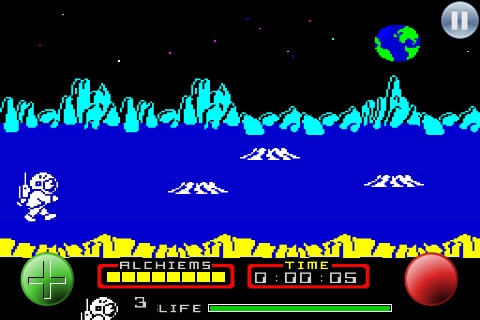
This is a 25-year commemorative edition (£1.19/€1,59/$1.99) of a game from the glory days of the Spectrum and the Commodore 64. It contains a faithful port of the 8-bit original (specifically the Spectrum 128 version) and an 2010 remake with some new gameplay features and objectives, but they both play very similarly. If you loved Nodes back in the day, you’re probably going to be very happy with this polished release. If you’re of a more modern era, you’re probably going to go “Huh?” and roll your eyes at what your grandad used to consider a top-notch game.
If you’re pushed for time, you can pretty much stop reading there.
Hello! Glad you could join us in the below-jump section of the review. For the benefit of fresh-faced newcomers, Nodes Of Yesod is a simple exploration-based platform game, in which you have to wander through lots of subterranean caverns (256 of ‘em, to be exact) in search of “alchiems”. The action takes place on single static screens, and you flick between them whenever you reach the edges. (Yes, there was a time when you couldn’t take scrolling play areas for granted.) Baddies patrol the caves, and falling a very long way will kill you.
It is – and remember, we’re still talking to the fresh-faced newcomers here – pretty slow and pretty boring. There’s a lot of trial and error as you have to leap blindly into new caves, jumping requires painstaking and fiddly accuracy, and not an awful lot actually happens – you just explore screen after screen until you find all the alchiems.
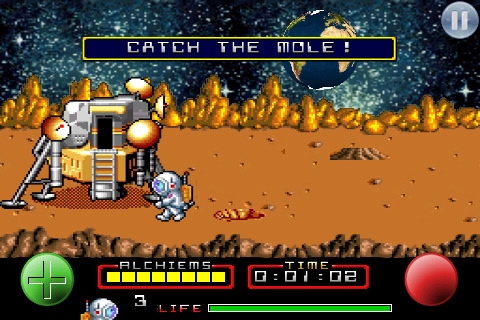
The new version is prettier (maybe 16-bit quality graphically, at a push) and gives you a map of sorts to navigate with, but is essentially the same game – it just makes you trek around a bit more. For example, before you can collect any alchiems you have to find a gun, then use it to kill some worms to get a glove. You’re told where everything is, so it’s just errand-running. Honestly, you’re not going to like it.
Pre-existing Nodes Of Yesod fans, however, are going to be pleased, because this is very much the same game you loved back in 1985. The virtual-pad controls work surprisingly well, perhaps because the d-pad is kept really tiny. This means that you quickly learn to make very small movements (helping keep responses fast), and that your thumb obscures almost none of the play area. You release the mole by simply tapping on your character, and the feel is exactly like that of the original.
(Cleverly, you can also tilt your iThing to make Charlie move very slowly in that direction, for when you need real pixel precision on a jump.)
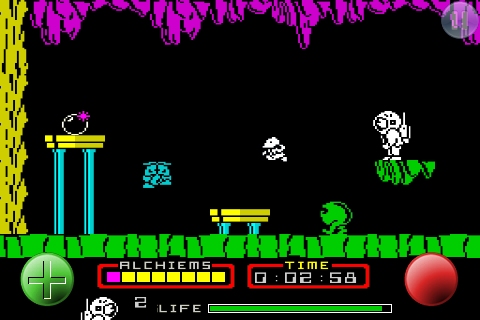
I rather enjoyed the uncommonly sedate pace and the simple pleasures of exploring a lot of mostly-empty caves, but it’s hard to say how much of that was down to nostalgia. I certainly didn’t really get on with the new version – the graphics are a bit Amstrad-y and the way the map tells you where you need to go takes the fun out of just poking around. Don’t get me wrong – rationally it’s unquestionably an improvement, but it just doesn’t feel right. Somehow getting bounced around randomly by all the rubbery enemies is a lot more annoying when you know exactly where you want to be. Half the fun of Nodes was bumbling around at your own pace seeing what you’d stumble across, but the updated version is more like work.
And man, it’s hard to believe we used to put up with games as frustrating as this, where it could take five minutes of effort to climb up just two screens, only to then have to jump into darkness and risk falling to a random death when we only had three precious lives and no continues. (Now your game is saved if you quit out, and contrary to my initial impression you can continue when you’ve lost your three lives, which rather begs the question “Why bother having lives at all?”, since there isn’t any scoring.)
£1.19 is possibly also a little hopeful when the Elite Collection gives you six old Speccy games for 59p, but this is a league above that in quality terms. It’s a loving, celebratory port, and so long as you know what you’re getting you’ll like it very much. Youngsters, go and happy-slap your Facebook page or whatever it is you do these days.


Yeah, I thought it was a well done port and I don’t begrudge splashing out on it but it’s still Nodes Of Yesod.
Which means it’s better than Underwurlde but worse than most games made since.
Still, I’d love to see more authors take Steve’s lead and get some of their old stuff up there.
When i was little, in my head i often said the name of this game backwards, i.e. Dosey Fo Sedon, i think i got a little obsessed with it and this review has made me start doing it again ;-(.
Thx for the review RevStu.
I’ve posted a couple of responses to the review on the Nodes mini-blog site (http://nodesofyesodgame.blogspot.com) but figured I may as well post here.
You made an update regarding continues (the game has infinite continues, just resume to continue) but then asked, “why bother when the game has no scores?”
In fact, the game has a “percent complete” score (we use OpenFeint to surface the leaderboard itself). One of the factors in the percent complete score is the number of lives you have “used” at the point a high score is submitted. Losing a lot of lives will significantly reduce your overall score.
Agreed that this is not obvious when playing the game, but there you have it.
Anyway, thanks again for the review. I think it is pretty accurate and fair.
Steve Wetherill
Cheers for the info, Steve. It does still rather beg the question “What’s the point of having three lives?”, though. If you can continue infinitely and losing more lives affects your score, why confuse people with an essentially meaningless “Game Over” message after three? Why not just have infinite lives, a display telling you how many you’ve lost, and the opportunity to start a completely new game if you want a clean slate?
Stu – the scoring generally follows the model of the original game, which had three lives, etc. Continue was added to classic mode late in the day mostly because it is quite hard to complete the original game without it (and we wanted to complete the game ourselves as part of our testing). For a while there was no continue in classic mode, but we thought better of that.